SMS Gateway: What It Is, How It Works, and How to Set One Up for Your Business
Mohit Selly
An SMS gateway is the infrastructure layer that lets a business application send and receive text messages through telecom networks, rather than through a phone's native messaging app. For any company sending OTPs, order updates, or fraud alerts at scale, the SMS gateway isn't a backend detail; it's the thing standing between a critical message and a customer who's waiting on it.
Most teams treat SMS gateway setup as a quick API integration: pick a provider, grab an API key, start sending. Then messages start failing silently: no error, no bounce, just a customer who never got their OTP and a support ticket that says (I didn't receive any code.)That's the moment teams realise an SMS gateway is an infrastructure decision, not a checkbox.
This guide covers what an SMS gateway actually does, the three types you'll encounter, how to set one up step by step, what separates a reliable provider from a risky one, and the mistakes that quietly tank delivery rates, with a specific look at what changes when you're operating under India's DLT compliance regime.
What Is an SMS Gateway and How Does It Work
An SMS gateway is a system that connects a business's software (a website, app, or CRM) to the mobile telecom network, converting outbound messages into a format telecom carriers can deliver, and converting inbound replies back into something the business application can read. In practice, it's the bridge between (my app needs to send a text) and (that text actually lands on someone's phone.)
SMS Gateway vs SMS API: What's The Difference?
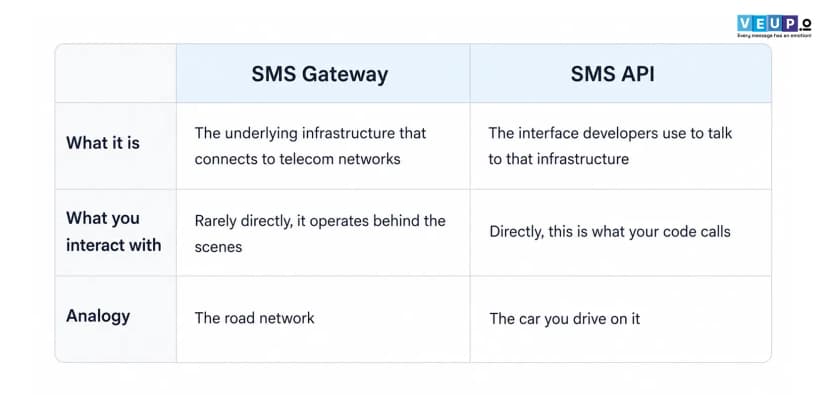
In Short: The API is how you send the request; the gateway is what actually gets the message delivered. Most providers bundle both, which is why the terms get used interchangeably, but understanding the distinction matters when you're troubleshooting delivery issues, because a failure could sit at either layer.
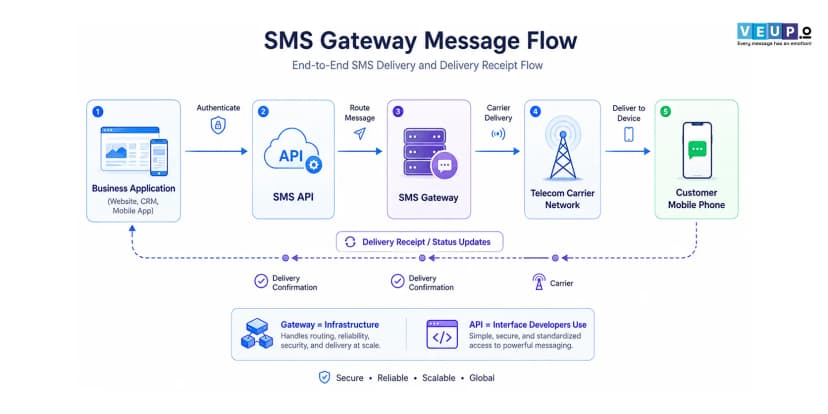
Functionally, here's the path a message takes: your application sends a request to the gateway's API, the gateway authenticates and formats the message, it routes the message to the right telecom carrier (or aggregator), the carrier delivers it to the recipient's device, and delivery status flows back through the same chain so your application knows what happened.
The Three Types of SMS Gateways (and When to Use Each)
Not every business needs the same kind of gateway. Picking the wrong type is one of the more common early mistakes, mostly because the differences aren't obvious until you hit a wall.
- Cloud-based / Hosted gateways: The provider runs the infrastructure; you connect via API or web dashboard. This is the right fit for the vast majority of businesses; fast to set up, no hardware, and scales without your involvement. Most enterprise SMS gateway use cases (OTPs, transactional alerts, marketing) run on hosted infrastructure.
- On-premise gateways: The business runs its own SMS server hardware (often using GSM modems or SIM banks) on-site. This is rare today outside of very specific compliance or data-residency requirements, since it shifts the burden of uptime, scaling, and carrier relationships entirely onto the business itself.
- Hybrid gateways: A mix of the two; typically cloud-managed routing with some on-premise components for specific compliance or latency needs. Common in BFSI and government contexts where certain data can't leave a controlled environment, but general routing can.
- For most IT managers evaluating a bulk SMS gateway or transactional SMS gateway, the decision starts and ends with cloud-based; the other two are edge cases driven by specific regulatory or infrastructure constraints, not general best practice.
How to Set Up an SMS Gateway: Step-by-Step
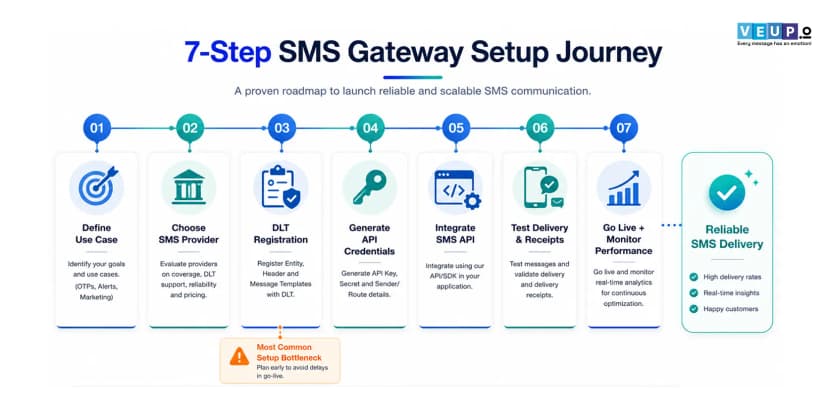
Here's the practical sequence for SMS gateway setup, from provider selection to first message sent.
- Define your use case and volume. Transactional (OTPs, alerts) and promotional (marketing) traffic have different compliance rules and routing requirements in India; know which you're sending before you pick a provider.
- Choose a provider based on evaluation criteria, not just price. (Covered in detail in the next section.)
- Complete DLT registration. In India, this means registering your entity, header (sender ID), and message templates with the relevant telecom-authorised DLT platform before you can send transactional or promotional SMS. This step alone trips up more first-time setups than any technical integration step.
- Generate API credentials and review documentation. Most providers issue an API key and SDK/documentation for common languages (Node, Python, PHP, Java).
- Integrate the API into your application. This typically means adding a simple HTTP request at the point in your code where a message needs to trigger; for example, right after an OTP is generated, or an order status changes.
- Test in a sandbox or low-volume environment first. Send test messages across multiple carriers and devices before going live and confirm delivery receipts are flowing back correctly; this is also the point to verify OTP delivery security is configured correctly, since OTP flows have unique failure modes around timing and retry logic.
- Go live, monitor delivery rates, and set up fallback. Treat this as ongoing, not a one-time task; delivery rates can shift with carrier changes, DLT template issues, or seasonal traffic spikes.
A realistic scenario: Picture a mid-sized D2C ecommerce company processing a few thousand orders a day. Order confirmation and delivery update SMS were running fine for months, until a routine catalogue migration triggered a spike in OTP-based login attempts during a flash sale. Delivery rates quietly dropped to around 80% for about six hours. No alerts fired, because the gateway was technically (working) messages were being accepted by the carrier, just not all reaching handsets, a classic grey-route symptom.
Support tickets piled up before anyone noticed the pattern. The fix wasn't a new gateway; it was adding real-time delivery rate monitoring and a fallback route, so failures would surface immediately instead of showing up as a wave of (I never got my code) complaints three hours later.
What to Evaluate in an SMS Gateway Provider
Provider names and pricing tables age quickly; what doesn't change is the set of questions worth asking before you commit.
- Delivery infrastructure and routing quality: Does the provider route through direct carrier connections or through layers of resellers? More hops generally means more points of failure and a higher chance of grey-route delivery, where messages get (delivered) through unofficial routes that carriers can block without warning.
- DLT compliance support: Especially for India-based sending, can the provider guide you through DLT registration, template approval, and header registration, or are you on your own? This is a genuine point of differentiation, since DLT processes change periodically, and a provider with dedicated compliance support saves real operational time.
- Fallback and failover capability: What happens when a message fails to deliver on the primary route? A provider offering SMS fallback routing, automatically retrying through an alternate channel or carrier path, turns a silent failure into a recovered delivery.
- Delivery rate transparency and reporting: Can you see real delivery receipts (not just (sent) status) in near real time? This is the difference between catching a problem in minutes versus finding out from a support ticket.
- Two-way messaging support: If your use case involves replies (confirmations, opt-outs, conversational flows), confirm the gateway supports two-way SMS gateway functionality natively, not as a bolt-on.
- Scalability under load: Ask specifically how the provider handles traffic spikes; flash sales, OTP floods during high-login periods, and festival-season order volumes, since this is exactly when delivery problems tend to surface.
- A2P SMS for BFSI: In particular, carries additional scrutiny, fraud alerts and transaction OTPs are time-sensitive in a way generic notifications aren't, so evaluate providers with that urgency in mind.
How VeUp's SMS Gateway Infrastructure Handles Scale and Compliance
VeUp's SMS gateway is built around the evaluation criteria above rather than around any single one of them: direct carrier-grade routing, built-in DLT-aware workflows for Indian businesses, and automatic fallback when a primary route underperforms.
For enterprises in BFSI, ecommerce, logistics, and healthcare, the practical benefit is fewer silent failures; delivery status, fallback triggers, and DLT-related flags surface in one place rather than requiring separate tools to piece together what happened to a message after it left your application. It's part of a broader omnichannel approach, where SMS sits alongside other channels as one coordinated delivery path rather than an isolated system to monitor on its own.
Common Setup Mistakes That Kill Delivery Rates
- Skipping or rushing DLT registration. Incomplete or mismatched header and template registration is one of the most common reasons messages get silently blocked in India, the request goes out, the provider shows it as (sent,) and it never reaches the handset.
- No fallback route configured. Treating the SMS gateway setup as a single point of integration with no backup path means any carrier-side hiccup becomes a full outage with no early warning.
- Ignoring delivery receipts. Many integrations only check whether the API call succeeded, not whether the message was actually confirmed delivered. These are different signals, and conflating them is how silent failures go unnoticed for hours.
- Using a single sender ID for mixed traffic types. Mixing promotional and transactional content under one header can trigger compliance flags or throttling, since DLT rules treat these traffic types differently.
- Not load-testing for peak scenarios. A gateway that performs fine at normal volume can behave very differently during a flash sale, festival period, or mass OTP event, and that's exactly when failures cost the most.
Conclusion
Frequently Asked Questions
Related Posts